
 Logistics Portal


Mountains of PET bottles and other (plastic) waste wash up on beaches around the world every day. Not only does this spoil the idyllic vacation atmosphere, but these mountains of trash also pose a real environmental problem. Plastic bottles take about 400 years to decompose—and then end up as microplastics in our waterways and soil.
Yet much of what ends up as trash is actually usable raw material. That’s exactly what the Indian textile company Shobikaa Impex Pvt. Ltd. realized. So it opted for a production concept based on ecological principles that comes quite close to a circular economy. “From Trash to Treasure,” says Marappan Sivasamy, Managing Director at Shobikaa Impex, summing up the concept in a single sentence.
From the bottle to the finished textile product
At four company-owned collection centers—in Bengaluru, Chennai, Coimbatore, and Kochi—the collected waste is sorted and separated into polyester and non-polyester materials. Contaminants are then filtered out of the polyester waste in several steps. As a result, 370 metric tons of plastic bottles—that’s 20,000 metric tons per year—are rescued from the ocean each week and returned to the product cycle.
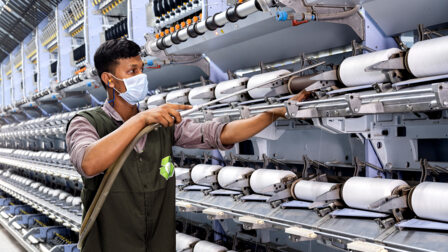
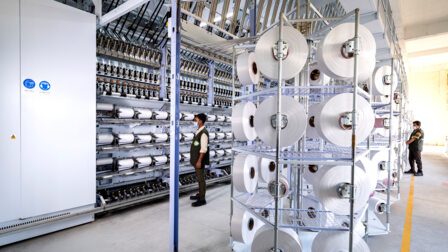
The South Indian company covers the entire process chain, from material collection through chips and melt processing to yarn production, further processing into textile fabric, garment manufacturing, and packaging. The recycled polyester waste is processed into filament yarns, which Shobikaa Impex uses primarily to produce mosquito nets. Under the GreenNet label, the company—founded in 2009—successfully markets the world’s first sustainable mosquito net.
Expansion into the apparel sector
Because these eco-friendly products have been so well received, Shobikaa’s management decided to diversify several years ago. Today, this forward-thinking company also manufactures yarns made from recycled polyester for the international apparel market. Recycled yarns are increasingly in demand, particularly among high-end brands. Key factors driving this trend include not only growing consumer awareness but also the planned sustainability strategies of governments in numerous industrialized nations. As the only polyester filament yarn producer in South India, the managing director of Shobikaa Impex sees significant growth potential for his recycled yarns in the apparel sector.
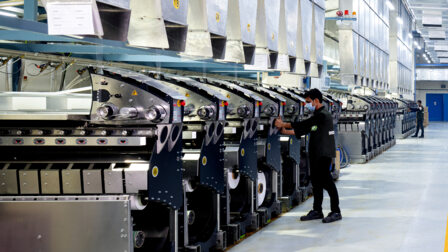
When it comes to technology, Shobikaa relies on Barmag. As Marappan Sivasamy explains: “In the face of international competition, there are very high standards for yarn quality and color consistency. With spinning systems and texturing machines from Barmag, we can definitely meet these requirements.” Precise metering and homogeneous mixing of the melt ensure stable processes, reduce waste rates, and minimize unplanned production interruptions. This directly leads to an improved cost structure per kilogram of yarn produced—a key driver of competitiveness, especially in price-sensitive markets such as India.
The perfect complement is the 3DD mixer from Barmag’s subsidiary BBE: It enables excellent color uniformity, particularly for recycled yarns, which are often processed as spin-dyed products. Thanks to the flexibly adjustable speed of the hot-melt extruder with dynamic mixing function, the mixing process can be optimally adapted to different formulations. In combination with a side-stream extruder and a precise metering pump, the system enables highly accurate and reproducible incorporation of color components within the required range. This results in a highly flexible solution that allows for quick response times to color changes and small batch sizes, making it ideally suited for dynamic market demands in the Indian market.
Sustainable production
The company also demonstrates its foresight in the manufacturing of its products. Here, too, Shobikaa Impex is committed to sustainability. Currently, 80% of its energy needs are met by green energy sources. To this end, all of its buildings are equipped with solar panels. With its “Zero Discharge” policy, the company is also committed to keeping land and water clean. This makes Shobikaa Impex a pioneer on the path to a clean textile industry.