
 Logistics Portal


Partnering for Performance - How integrated service concepts sustainably boost the performance of spinning systems


Many production facilities in the man-made fiber industry have one thing in common: They are technically sound and reliable — yet some parts are no longer state-of-the-art. This is precisely where a dilemma arises that many man-made fiber manufacturers are familiar with: How can I keep existing equipment running economically and efficiently without investing in a completely new system?
The answer lies in a consistent Partnering for Performance approach to customer service.
CORE - Cost-Optimized Runtime Extension
With the CORE approach, customer service becomes a strategic component of value creation. The focus is on a clearly defined goal: to specifically extend the service life of existing plants while optimizing costs.
Specifically, this means:
- Existing technology is retained where it has proven its worth.
- Critical components are selectively modernized.
- Obsolete parts are replaced without having to rebuild the entire system.
This approach combines the best of both worlds: the stability of existing machines with the performance of modern technologies. The Original Equipment Manufacturer (OEM) plays a central role in this process, providing integration, quality assurance, and comprehensive support all from a single source.
Modular modernization instead of complete replacement
CORE achieves its impact primarily through targeted, modular upgrades along the entire process chain. Rather than considering individual measures in isolation, this creates a coordinated solution tailored to the specific requirements of the plant.
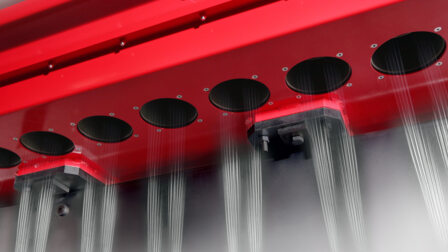
In the areas of extrusion, spinning, and quenching, the focus is on making existing systems more efficient and flexible. Increased throughput and the ability to adapt to different materials make it possible to meet new market demands — without having to invest in a completely new system. In addition, third-party components can be integrated, or specific retrofit solutions such as EvoQuench can be implemented. In this way, the existing setup is specifically enhanced and adapted to changing conditions.
In take-up and winding as well, the approach centers on optimizing existing systems. This includes, for example, modernizing the take-up section — including integration with the existing spinning section —or replacing individual units, as well as the modular replacement of key components such as godets. This is complemented by electrical upgrades and comprehensive system upgrades. The result is a more stable, more reliable production with significantly higher process reliability.
At the same time, the targeted refinement of process parameters and process software ensures additional performance gains. By adjusting key parameters such as speed or temperature, processes can be controlled more precisely and adapted to new requirements. The integration of remote access capabilities also lays the foundation for greater transparency and faster response times during ongoing operations.
All in all, this results not in a hodgepodge of individual measures, but in an integrated solution that systematically enhances existing systems — with the goal of sustainably increasing flexibility, stability, and performance.
Customer service as an integrated solution process
What connects these measures is not so much the individual technical solution as the approach behind it: service is understood as an interplay of analysis, development, and implementation. The key difference lies in how service is utilized: it does not begin only when something is not working, but rather helps to improve processes from the outset and increase performance in a targeted manner.
Above all, one thing takes center stage: responsibility. From our customers’ perspective, this means having a partner by their side who cares — consistently and for the long term. Even when plants have been in operation for decades. This is precisely where the strength of this approach lies: Existing plants are not simply replaced or written off, but are purposefully upgraded. Drawing on experience, technical expertise, and a clear focus on cost-effectiveness, we identify tailored, cost-optimized solutions that deliver real added value. This ongoing commitment makes all the difference and clearly sets our service apart from the competition.
For man-made fiber manufacturers, this results in concrete economic and technological benefits: Existing equipment can be used for longer, investments can be planned more strategically, and at the same time, process stability and product quality are sustainably improved. Production remains flexible enough to respond to new materials and changing market demands. In short: Existing equipment is not replaced, but rather sensibly upgraded.
This makes service an integral part of everyday production. It contributes directly to operating plants efficiently, keeping costs under control, and ensuring long-term competitiveness.